🎉 Multiple Papers of Our Team Have Been Accepted by TIP
Two papers of our team have been accepted by IEEE Transactions on Image Processing recently.
Paper 1: Uncertainty Modeling for Gaze Estimation
📄 Uncertainty Modeling for Gaze Estimation
Authors: Wenqi Zhong, Chen Xia, Dingwen Zhang, Junwei Han
Journal: IEEE Transactions on Image Processing
Research Background
Gaze estimation is an important fundamental task in computer vision and medical research. Existing works have explored various effective paradigms and modules for precisely predicting eye gazes.
However, the uncertainty for gaze estimation, e.g., input uncertainty and annotation uncertainty, have been neglected in previous research. Existing models use a deterministic function to estimate the gaze, which cannot reflect the actual situation in gaze estimation.
Key Contributions
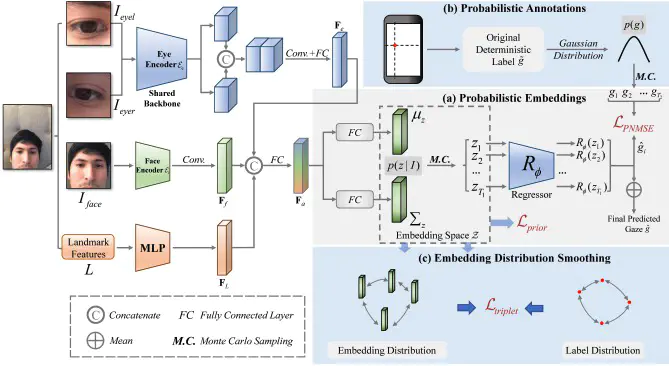
To address this issue, we propose a probabilistic framework for gaze estimation by modeling the input uncertainty and annotation uncertainty.
Main innovations include:
- We utilize probabilistic embeddings to model the input uncertainty, representing the input image as a Gaussian distribution in the embedding space.
- We give an instance-wise uncertainty estimation to measure the confidence of prediction results, which is critical in practical applications.
- We propose a new label distribution learning method, probabilistic annotations, to model the annotation uncertainty, representing the raw hard labels as Gaussian distributions.
- We develop an Embedding Distribution Smoothing (EDS) module and a hard example mining method to improve the consistency between embedding distribution and label distribution.
Experimental Results
We conduct extensive experiments, demonstrating that the proposed approach achieves significant improvements over baseline and state-of-the-art methods on two widely used benchmark datasets, GazeCapture and MPIIFaceGaze, as well as our collected dataset using mobile devices.
Paper 2: Weakly Supervised Semantic Segmentation via Alternate Self-Dual Teaching
📄 Weakly Supervised Semantic Segmentation via Alternate Self-Dual Teaching
Authors: Dingwen Zhang, Hao Li, Wenyuan Zeng, Chaowei Fang, Lechao Cheng, Ming-Ming Cheng, Junwei Han
Journal: IEEE Transactions on Image Processing
Research Background
Weakly supervised semantic segmentation (WSSS) is a challenging yet important research field in vision community. In WSSS, the key problem is to generate high-quality pseudo segmentation masks (PSMs).
Existing approaches mainly depend on the discriminative object part to generate PSMs, which would inevitably miss object parts or involve surrounding image background, as the learning process is unaware of the full object structure.
Key Contributions
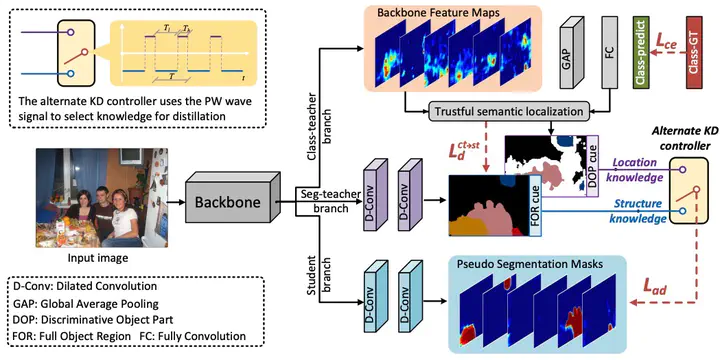
To fully explore these two information cues, we build a novel end-to-end learning framework, alternate self-dual teaching (ASDT), based on a dual-teacher single-student network architecture.
Main innovations include:
- The information interaction among different network branches is formulated in the form of knowledge distillation (KD).
- Inspired by the Pulse Width (PW) modulation, we introduce a PW wave-like selection signal to alleviate the influence of the imperfect knowledge from either teacher model on the KD process.
Experimental Results
Comprehensive experiments on the PASCAL VOC 2012 and COCO-Stuff 10K demonstrate the effectiveness of the proposed ASDT framework, and new state-of-the-art results are achieved.
Conclusion
These acceptances by IEEE Transactions on Image Processing represent significant contributions to the field. The first paper advances gaze estimation through uncertainty modeling, while the second paper pushes the boundaries of weakly supervised semantic segmentation.
Congratulations to Wenqi Zhong, Dingwen Zhang, Hao Li, and all co-authors for these outstanding achievements! 🎊